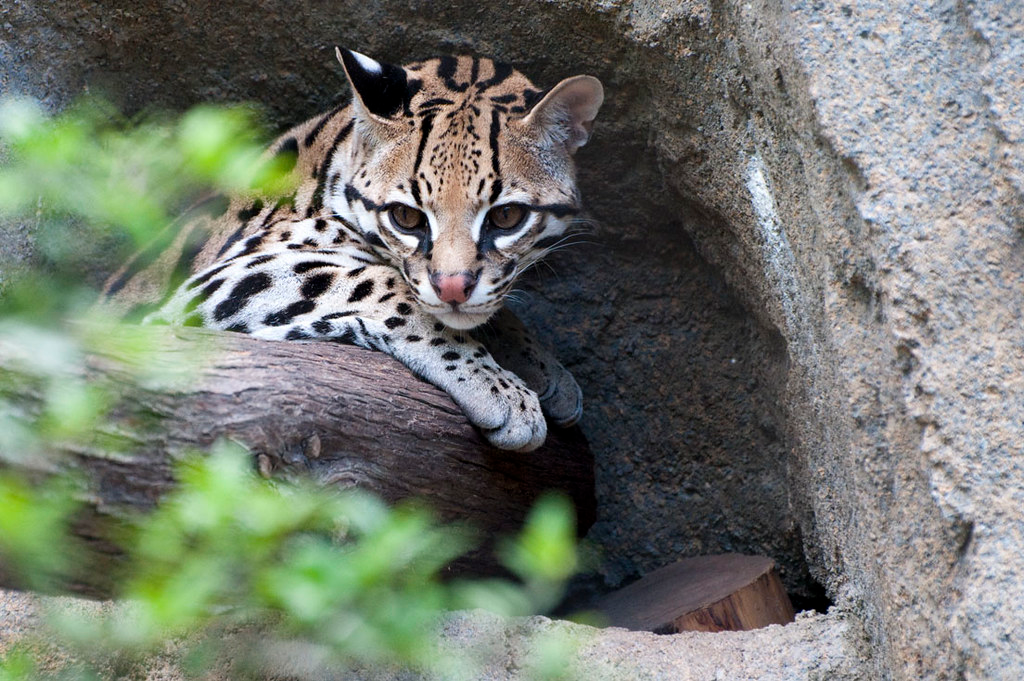
Intro.
Ocelots are a beautiful cat. With stripes near their eyes and spots on their bodies, they are very pretty. They are also very small. I would also like to state that ocelots are not very commonly seen in the wild.

“Ocelot Houston Zoo” by BFS Man is licensed under CC BY 2.0.
Habitat.
Ocelots inhabit the tropical forest, marsh, and grasslands of the southern United States and the central and south Americas. Their scientific name isLeopardus pardalis. They are usually about 15–35 pounds which is 7–16 kg, and they eat small mammals and birds along with reptiles and some types of fish. They are the largest and one of the most beautiful of the small and spotted cats, and they are also skilled at climbing, swimming, and hunting. Males like to patrol territories and stake out where a few females live.

“Ocelot” by Marie Hale is licensed under CC BY 2.0.
Populations.
Ocelots were always rare, but they maintained a population of 700 in the southwestern untitled states until their habitats were destroyed by human development. Today, there are around 800,000 to 1.5 million in the wild. But back in 2015, only around 100 of them lived north of the Mexican border. In the United States, particularly in southern Texas where ocelots are extremely rare, federal and state authorities have implemented habitat protection measures under the Endangered Species Act. Thanks to that, we have more ocelots in the wild.

“Ocelot (Leopardus pardalis)-8” by Ana_Cotta is licensed under CC BY 2.0.
Biology.
Ocelots are nocturnal and solitary by nature, usually coming together only to mate. They are highly territorial animals; males often have larger territories that overlap with those of several females, but they defend their areas vigorously from other males. Communication is done through scent marking, vocalizations, and visual cues. Despite their relatively small size, ocelots are skilled hunters. They prey on a variety of small animals, including rodents, birds, reptiles, amphibians, and even fish when near water sources. Their climbing ability is remarkable—they can climb trees and shrubs to escape predators or stalk prey from above.

“Ocelot (Leopardus Pardalis), Santago” by spencer77 is licensed under CC BY 2.0.
conservation effort’s.
Ocelots occupy a very strange position in modern wildlife conservation. On paper, it is not considered globally endangered. In reality, many of its populations are declining. The biggest threat to ocelots is habitat loss. Dense, continuous vegetation is critical for their survival, and large-scale land conversion for agriculture, cattle ranching, urban development, and resource extraction has destroyed vast areas of suitable habitat. Even where forest remains, selective logging or understory clearing can render areas unsuitable by removing the cover ocelots rely on for hunting and concealment. Fragmented landscapes divide populations into small, isolated groups, limiting dispersal and breeding opportunities that are essential for ocelot survival. This could lead to inbreeding and genetic malfunctions within these groups.

“Ocelot” by brian.gratwicke is licensed under CC BY 2.0.
Problems/threats.
Road networks pose an another and usually very underestimated threat. Ocelots are naturally hesitant to cross open spaces, but habitats being split into pieces force them to traverse roads while moving between patches or searching for potential mates. Vehicle collisions are the biggest cause of death in the northern populations, especially in South Texas. Each road mortality represents not just the loss of an individual, but a significant genetic and reproductive setback for already small populations. Again, this dads to the inbreeding and genetic malfunctions that I have already mentioned in this post.

“Ocelot Head” by ahisgett is licensed under CC BY 2.0.
Human problems.
Human exploitation has also changed and molded the species’ conservation history. During the mid-twentieth century, ocelots were heavily hunted for the fur trade, with hundreds of thousands killed to supply international fashion markets. Although commercial trade has very much ceased due to international agreements, illegal killing still occurs in some regions. Ocelots may be shot in retaliation for predation on poultry, trapped accidentally, or captured for the illegal pet trade. Being exposed to poisons first intended for rats and rodents or other pests also contributes to deaths in the Ocelots population that is already suffering.

“Ocelot (Leopardus Pardalis), Santago” by spencer77 is licensed under CC BY 2.0.
families.
Despite being smaller than jaguars or leopards, ocelots are powerful predators with a strong ecological presence in the regions they inhabit. No two ocelots have the same pattern, making each individual visually unique. Their undersides are typically white, and they have bold facial markings, including dark lines running from the eyes down the cheeks.

“ocelot” by (: Rebecca-louise 🙂 is licensed under CC BY 2.0.
Hunting.
Ocelots have amazing hearing, their ears are so sharp, they are capable of detecting the faint movements of prey hidden under the lush vegetation or underground. Their eyes are adapted for conditions with low amounts of light. This allows them to hunt well in places of almost complete darkness, giving them a big advantage on prey as nocturnal predators. Their hunting strategy is based more on their stealth skills than speed. When they strike, it is sudden and amazingly precise. They are swift , fast, and VERY cool. They are known for delivering a killing bite to the back of the skull or neck, which quickly immobilizes their prey. Unlike some other larger cat, ocelots often eat their prey on the spot but might drag it to a more hidden location if disturbed by a sound of a possible predator or threat.

“Sihil the Ocelot” by MrGuilt is licensed under CC BY 2.0.
Gender differences in territory.
Male ocelots generally maintain much larger territories than females. A single male’s range may overlaps with the territories of more than one female, which upgrades his chances of getting a mate or mating. Female territories, are smaller and more exclusive, especially when they are raising kittens. Females prioritize areas with more prey and safe den sites, since kittens depend 100% on their mother for many months.

“…OCELOT…” by Martyn Wright is licensed under CC BY 2.0.
Scent markers.
Ocelots rely heavily on scent to define and defend their territories. They mark boundaries by spraying urine on trees, bushes, and rocks, and by leaving feces in prominent locations along trails. They also use scratch marks on tree trunks and scent glands on their cheeks and paws to leave chemical signals behind. These markings communicate vital information to other ocelots, such as whether an area is already occupied, the sex of the individual, and whether it is ready to breed. This system reduces the need for physical confrontation, which could result in injury.
fights over territory.
Although ocelots are solitary, territorial disputes do occur, especially between males. When conflicts happen, they may begin with vocalizations such as growls or yowls, followed by aggressive posturing. Physical fights are relatively rare but can be intense, as both animals are defending access to food and mating opportunities. Because of this risk, ocelots usually try to avoid direct encounters by respecting scent marks and adjusting their movements.

“Ocelo baby 1” by Mark Dumont is licensed under CC BY 2.0.
Mating.
Mating can occur at any time of year. When a female enters estrus, (When a female can mate) she signals her reproductive readiness through vocalizations and scent markings. Males may respond by traveling into the female’s territory, sometimes crossing the boundaries of other males in the process. If more than one male arrives, competition can happen, though it is often resolved through displays, meowing, or scent assessing rather than actual physical fighting. After mating, the male plays no further role in parental care. The female alone is responsible for pregnancy, birth, and raising the kittens. After a gestation period of roughly two and a half to three months, the female gives birth to a small litter, usually one or two kittens, though sometimes three. Birth usually occurs in a well-hidden den, such as a hollow tree, cave, or abandoned burrow, where the kittens are protected from predators and bad weather.

“Ocelot baby 2” by Mark Dumon is licensed under CC BY 2.0.
KITTENS!!!!
Newborn ocelot kittens are blind, deaf, and completely rely on their mother. (They are very cute though.)Their fur is darker than an adult, which helps them blend into the shadows of the den. For the first few weeks, the mother leaves the den only minimally to hunt, returning very very often to nurse and groom her kittens. During this time, she uses secrecy and may move the kittens to a new den if she senses any type of danger. As the kittens grow, their eyes open.

“New Ocelot 4 (8489694684)” by Tony Hisgett from Birmingham, UK is licensed under CC BY 2.0.
The mother slowly starts to introduce them to actual food by bringing back prey that she caught. The kittens only play with the prey at first, which actually helps them develop strength, coordination, and hunting instincts over time. After a while, They start to accompany their mother on very short trips outside the den, watching how she stalks, ambushes, and kills prey.

“Ocelot (Leopardus pardalis)” by brian.gratwicke is licensed under CC BY 2.0.
Kittens usually nurse for multiple months, but they stay with their mother for much longer, usually up to two years. During this extended time, the mother teaches them how to hunt and how to navigate territory, recognize threats, and avoid other predators and humans. Eventually, the now juvenile kittens disperse, leaving to establish their own homes. This dispersal period is one of the most dangerous times in an ocelot’s life, because young juveniles have to cross unfamiliar terrain, avoid dominant adults, and find good habitat without already established scent markers. Many do not survive, because of the fragmented landscapes left in the wild today.

“Ocelot” by jitze is licensed under CC BY 2.0.
Illegal pet trade.
Most ocelots sold illegally are taken directly from the wild. Poachers often capture kittens, and in many cases the mother is killed. The captured ocelots are then smuggled across borders in very cramped, stressful conditions. Many do not survive the transportation due to dehydration, injury, or disease. Sellers might also lie that the animals are captive-bred in order to avoid suspicion from law. Ocelots make bad pets because their physical and behavioral needs cannot be fulfilled in a house environment. They need very large territories, mental stimulation, and specialized diets. Even when hand-raised, ocelots do not behave like domestic cats and usually suffer from chronic stress in captivity.

“Leopardus pardalis– Ocelot (27328421953)” by Dick Culbert from Gibsons, B.C., Canada is licensed under CC BY 2.0.
Indigenous roles.
Culturally, ocelots have been important to a lot of Indigenous civilizations in the Americas. In Mesoamerican cultures, including the Maya, ocelots were associated with warriors, night, and power. Maya rulers and elites linked ocelots with authority and warfare. In Maya art, ocelot patterns appear on clothing, shields, and thrones, strengthening the connection between leadership and predatory power.

“Ocelot” by Scriblerus is licensed under CC BY 2.0.
Thank you for reading, I hope you enjoyed this post, and I will see you in the next one!
— Gloryrules
Comments
3 responses
Hi, please leave a comment!
Hanae,
Wow! Congratulations!
Such an amazing blog of animals!
Well done! Keep up the unbelievable work!!!
Best,
L
Hanae,
Wow! Congratulations!
Such an amazing blog of animals!
Well done! Keep up the unbelievable work!!!
Best,
L