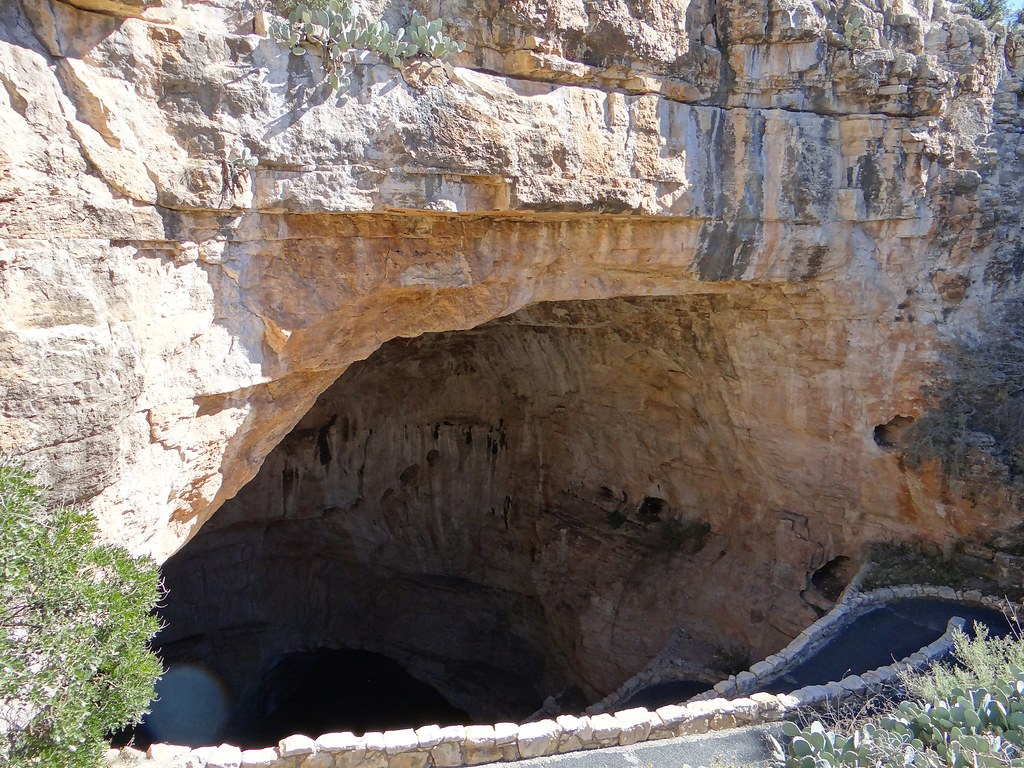
Underneath the harsh, desert landscape of the southern parts of New Mexico lies one of the most outstanding US national parks : Carlsbad Caverns. Carlsbad Cavern is a huge cave system about 250 million years old. Carlsbad Caverns National Park shelters a vast network of caves carved deep within ancient limestone, shaped over millions of years by powerful sulfuric acids rising from below its largest caverns. Enormous chambers, delicate mineral formations, and more than 100 known caves. Each evening the sky comes alive as thousands of bats soar out of the cave searching for food in the desert above.

“Carlsbad Caverns Natural Entrance” by U.S. Geological Survey is marked with CC0 1.0.
You may enter the cavern museum inside the visitor center or get a junior ranger program workbook or something (By the way, the junior ranger program is for 5-13, but they may have a book for younger ages) and hang out but then you will go outside to the bat flight amphitheater whether it is open or closed, then you will enter the caves after a short safety hearing from a ranger as this is a national park.

“Carlsbad Cavern, New Mexico” by taylorandayumi is licensed under CC BY 2.0.
From the moment you step inside, you see a dark mass of DARK. Just DARK. It’s just amazing. Though you may not be able to resist gaging at the scent of bird and bat scat at the entrance. Further down the cave, you will hear the soft trickling of water leaking from the desert with small stalactites, the number increasing with every meter traveling down the cave.

“Inside Carlsbad Caverns” by OakleyOriginals is licensed under CC BY 2.0.
Now is probably a good time to mention the population of bats that live in this cave. The bats are: Mexican free-tailed bat, little brown bat, cave myotis, fringed myotis, long-legged myotis, big brown bat, and Townsend’s big-eared bat. The Mexican free-tailed bat forms enormous colonies of hundreds of thousands during summer, and their evening flights are a famous attraction. It is a beautiful sight to go watch. The little brown bat is smaller and more solitary, often roosting in cracks and other small nooks.

“Mexican free-tailed bats exiting Bracken Bat Cave” by USFWS Headquarters is licensed under CC BY 2.0.
The cave myotis and fringed myotis are insect-eaters that navigate the cave’s intricate passages. The long-legged myotis is named for its unusually long arms and legs, which help it hold on to cave walls. As you may know, bat feet are like wrenches. They can cling to any place they desire just by pulling down with body weight of being upside down. It takes more effort to release a bats grip than to hold it. The big brown bat is larger than most others in the cave and can live several years. Finally, last but not least, Townsend’s big-eared bat is notable for its massive ears and very sensitive hearing, making it highly adapted to catching bugs in the dark cavern ecosystem.

“Bat Flight Amphitheater” by daveynin is licensed under CC BY 2.0.
When you walk further, you will be dazzled by the beauty and strangeness of your surroundings. There are pillars upon pillars of a thick substance that looks like its slowly melting, and walls of cave popcorn, which is a very bumpy calcite that is commonly found in the caves, they are usually found in limestone caves and they resemble popcorn.

This photo is by the author.
Overhead you may see the huge stalactites and beside you, huge stalagmites that are so thin, you may wonder if they will fall down on top of you. The walk is beautiful, with the famous rope hanging overhead and ladder in which the first explorers climbed through the caverns. You feel a sense of history in these caverns around you as you walk further.

“Rookery, Lower Cave, Carlsbad Cavern” by CarlsbadCavernsNPS is marked with Public Domain Mark 1.0.
I also forgot to mention the sickness that is spreading through the bats right now. It is called “White-nose syndrome.” White-nose syndrome is a fungal sickness that affects hibernating bats. It is caused by the fungus Pseudogymnoascus destructans. Which loves the cold. It was first found in New York in 2006–2007 and has widely spread across a lot of the U.S. and Canada. The name comes from the white fuzzy growth of fungus usually seen on the affected bat’s nose, ears, wings or tail during winter hibernation. The fungus grows on the skin tissues, especially the wings, which are very important for flight, hydration, temperature regulation, and gas exchange.

“Little brown bat affected by White-nose Syndrome” by U. S. Fish and Wildlife Service – Northeast Region is marked with Public Domain Mark 1.0.
The effects on bat populations have been critical since its discovery. Some species, including little brown bats, northern long-eared bats, and tri-colored bats, have decreased by more than 90 percent in some parts of their normal range. Millions of bats have already died. AND there is no complete cure for white-nose syndrome in wild bat populations at the moment, and these are the effects of that: Without a cure, many infected bats die during their first or second winter after being exposed to the sickness. Some of the affected bat species have experienced regional population collapses.

Bat showing symptoms of White-nose Syndrome” by U. S. Fish and Wildlife Service – Northeast Region is marked with Public Domain Mark 1.0.
BUT. Extensive research is ongoing right now. Scientists are researching medicines and vaccines that could help bats resist infection and an early death. Field trials are happening in some areas. Researchers are also investigating ways of biological controls, such as bacteria that is beneficial and inhibit fungal growth on bat skin.

“White Nose Syndrome Surveillance at Rattlesnake Springs” by CarlsbadCavernsNPS is marked with Public Domain Mark 1.0.
White-nose syndrome represents a huge conservation crisis. It has permanently changed bat communities in North America. While it makes no actual danger to humans, its ecological impacts are large. Bats play an essential role in controlling insect populations, maintaining ecosystem health, and supporting farming and agriculture .

This photo is by the author.
As you journey farther into the darkness you make your way into the Big room. The Big Room is one of the largest cave chambers in North America — about 4,000 feet long, 625 feet wide, and 255 feet high in places. From there, you can choose to continue or to go back up to the surface. You are also able to use the restroom here before you continue. This is the time to take a break before continuing or you can quit here.

“‘The Giant Dome, largest stalagmite” by U.S. National Archives is marked with CC0 1.0.
Walking through it feels almost like entering an enormous underground cathedral. The Big Room is filled with a huge variety of cave formations, known as speleothems. Stalactites hang from the ceiling, stalagmites rise from the floor, and when they meet, they form towering columns. Flowstone, popcorn formations, and the quirky helictites add to the beautiful landscape. Notable features include the Giant Dome, a stalagmite standing about 62 feet tall, and the Bottomless Pit, which looks like a shaft stretching endlessly downward.

this photo is by the author.
The Big Room alone is enormous, stretching over 4,000 feet in length and 255 feet high in places, with ceilings dotted with formations that resemble chandeliers or frozen waterfalls. Hidden passages lead to smaller chambers like the Hall of the White Giant, the King’s Palace, and the Hall of the Dwarves, each with its own unique formations and eerie beauty. Some formations have names inspired by their shapes, such as the “Rock of Ages,” “Devil’s Spring,” or “Queen’s Chamber.” Ancient cave deposits like gypsum crystals, among others . Mineral deposits inside the cave include not just calcite but also gypsum, aragonite, and occasionally traces of other rare minerals.

this photo is by the author.
The air is cool and steady inside the caverns, usually around 56°F (13°C) year-round, with high humidity that helps preserve the very delicate formations. The walls and ceilings are covered with a beautiful array of speleothems, including stalactites hanging from above, stalagmites rising from the floor, and massive columns formed when the two meet. There are also draperies—thin, wavy sheets of rock often translucent—and helictites, which twist and curl. Flow-stones coat the cavern floors and walls with smooth, shimmering layers of calcite.

this photo is by the author.
The caves also host ecosystems adapted to darkness. Microorganisms live and thrive on minerals and organic matter, while Brazilian free-tailed bats use the chambers as summer roosts. Their guano (Scat) contributes nutrients to the cave environment, and their nightly flights help control insect populations above ground. Certain chambers, like the Big Room, produce echoes and amplified sounds due to the hard rock and vast open space. Flowstone terraces sometimes trap water droplets, creating tiny natural mirrors, and delicate formations like frostwork grow in needle-like clusters in select areas. Fossils of marine life from the Permian period have been found in the cave walls, evidence of the ancient seas that once covered the region.

this photo is by the author.
Cave crickets are one of the most common animals/ living creatures. They explore from the dark interior toward the entrances at night to feed, then return deeper into the cave. Their droppings provide a vital food source for other cave-dwelling creatures. Spiders, such as the cave orb-weaver, hunt these crickets and other small invertebrates. Small beetles, like the cave beetle, scuttle and crawl along walls and ceilings, feeding on fungal growths or decomposing matter. Some of these beetles are troglobites, meaning they are entirely adapted to life underground—they have no eyes and often pale, translucent bodies.

“Cave Cricket” by Greg Schechter is licensed under CC BY 2.0.
Other invertebrates include springtails, tiny wingless creatures that feed on fungi, bacteria, and organic debris. Millipedes and centipedes are also present, acting as decomposers or predators in the underground food web. In the moist pools and rimstone dams, small aquatic organisms, such as cave-adapted amphipods and isopods, survive in total darkness, feeding on microorganisms or detritus. Even small salamanders have been observed in some cave-adjacent moist areas, taking advantage of the stable temperature and humidity.

“Millipede (Paraustraliosoma sp.)” by Oriolus84 is licensed under CC BY 2.0.
Fungi and bacteria play an important role as well, breaking down organic material and supporting these invertebrate populations. The non-bat fauna of Carlsbad Caverns is a hidden, intricate ecosystem—small in size but complex, with each species uniquely adapted to life in complete darkness, dependent on tiny pockets of energy and nutrients that make it through from the surface.

“The giant Caves Fungi (* see cave macros)” by Lenny Montana is licensed under CC BY 2.0.
The cave system is composed mainly of limestone from the Capitan Reef, an ancient reef formed during the Permian period when the region was covered by a shallow sea. The reef was composed of the remains of marine organisms such as sponges, algae, and shell-forming creatures, which later hardened into limestone. Tectonic uplift raised this reef above sea level, and erosion exposed it to underground chemical processes. Fractures and faults in the rock provided pathways for gases and groundwater to move upward and outward, guiding where caves formed.

“Fossils” by naturenps is marked with Public Domain Mark 1.0.
The caverns include vertical shafts, domes, and pits that formed as acidic water drained downward and rock collapsed or dissolved away. Some ceilings show scalloped patterns that indicate past water flow direction and speed. Carlsbad Caverns formed primarily through a process known as sulfuric acid speleogenesis, which is different from the carbonic-acid process that forms most limestone caves. Deep below the surface, petroleum deposits released hydrogen sulfide gas. This gas moved upward through fractures in the limestone and mixed with oxygen-rich groundwater near the water table. When hydrogen sulfide combined with oxygen, it formed sulfuric acid, a much stronger acid than carbonic acid. This sulfuric acid dissolved the limestone from the inside outward, creating large chambers rather than narrow stream-cut passages.The reef was composed of the remains of marine organisms such as sponges, algae, and shell-forming creatures, which later hardened into limestone. Tectonic uplift raised this reef above sea level, and erosion exposed it to underground chemical processes. Fractures and faults in the rock provided pathways for gases and groundwater to move upward and outward, guiding where caves formed.

“Carlsbad Caverns National Park” by xiquinhosilva is licensed under CC BY 2.0.
when you get to the end after experiencing the rest of the cave, you will get to a area where there are shops and a restroom with a rubber floor INSIDE the cave, it looks like something straight out of Disney world. There are snacks and bottles of water along with a t-shirt shop. You will then board an elevator where you will reach the visitor center where everyone is acting like nothing just happened around you. Then you can get food at the shops or just buy a shit or a sweater or a stuffed animal or hand in a junior ranger workbook.
I hope you enjoyed this post, and it helped you or entertained you in any way.
— Gloryrules.
Comments
One response
This is a fun read!!