Intro
Barn owls are amazing special birds that are active usually at night. Their scientific name is Tyto alba. Cool right? Their calls sound like screaming and screeching. It was once even said that if one flew over your house, someone would die. This was likely because of the terrifying screeching noise of the Barn Owl. But today, we are talking about the many good traits of the Barn owl.

“Female Barn Owl 4” by ahisgett is licensed under CC BY 2.0.
Food and body.
The barn owl usually eats mice, voles and rats, as well as other small mammals. Like other owls, they are nocturnal and has asymmetrical ears that help them detect sounds more accurately but Barn Owls also has movable earflaps, gifting it with the most acute hearing of almost any animal. Cool right? Their feathers are super fluffy so they can move through the night without being discovered by nocturnal prey who rely on hearing. Barn Owls also have narrower skulls and do not have to ear tufts that most Owls have.

“Barn Owl – 10” by Wildlife Boy1 is licensed under CC BY 2.0.
Food (Again)
By the way, besides rodents, barn owls may also eat shrews, small birds, bats, frogs, and even large insects. However, these animals are usually a smaller part of their normal diet. Barn owls swallow their prey whole. (Don’t they choke?) Later, they cough up small pellets made of bones, fur, feathers, and other parts they cannot digest. Scientists study these pellets to learn what the owls have been eating and to understand local wildlife populations. These pellets are called cough pellets. Which is kind of disgusting, but who am I to question scientific stuff? These pellets may have bones in them.

“Barn Owl in a barn” by charlieishere@btinternet.com is licensed under CC BY 2.0.
Barn Owls live usu in open landscapes where hunting is easier. It prefers grasslands, farmland, meadows, savannas, and marshes rather than thick forests. These open habitats support big numbers of small mammals, which are its main source of food. I mean, easy meals are easy meals. For shelter and nesting, barn owls use natural and man-made structures. They roost in tree cavities, cliff holes, and rocky crevices usually. In rural areas, they often nest in barns, church towers, silos, and other quiet buildings. They do not build the iconic traditional nests but instead lay eggs directly on a flat surface in a sheltered space. (Don’t ask me why, I don’t know) hence their name, BARN OWLS. (Exclamation on the “BARN”)

“Barn Owl 2” by ahisgett is licensed under CC BY 2.0.
Parent barn owls often mate for life. They usually choose nesting sites in barns, tree cavities, or cliff ledges. The female usually stays in the nest, incubating ( warming) the eggs for about 30 days, while the male hunts and brings back food for the female. Once the eggs hatch, the female continues to brood the chicks to keep them warm, and the male provides most of their meals, tearing prey into pieces for the young. The chicks grow quickly and leave the nest at around 50 to 60 days old, with both parents continuing to feed them for several weeks after fledging. Experienced adult barn owls often have greater success raising their young because they are more skilled hunters and better at defending the nest.

This photo was taken at the Belize raptor center.
Competition among siblings is intense. Because food is delivered in limited quantities, older or larger owlets often get the most, and in years when prey is scarce, the youngest owlets may starve to death. This natural competition increases the survival chances of at least some of the brood. Its survival of the fittest. And IT IS TOUGH. As they reach seven to ten weeks old, the owlets begin “branching,” that’s where they start exploring the edges of the nest and hopping to nearby branches. This stage gradually develops into fledging, which is when they take their first real flights. During this time, the parents continue to feed them and teach hunting skills, but the owlets learn mostly through trial and error. Their hunting instincts develop quickly, with practice focusing on silent flight, sharp talon strikes, and listening for the movements of small mammals. And around twelve weeks, the owlets leave the nest permanently and start living independently. Survival rates are very low; studies show that in some regions, fewer than half of the owlets survive to being a mature Barn Owl due to predation, starvation, and accidents.

This photo was taken at the Belize raptor center.
But even the persistent Barn Owl is facing challenges. The meadows and grasslands in which the barn Owls live is getting turned into urban farmland which brings up the second problem. RAT POISON. Rat poison is not an instant effect thing. It takes time. Enough time that a predictor might come across the weak looking rat and think FOOD! But it is not food. And it is not food. It’s a death sentence. Many types of animals all face this problem. They eat rats. The rats are poisoned. They die. Sometimes animals even eat the poisoned carcasses. They die too. BUT. People are working to change that. When I learned about this rat poison crisis at the Belize raptor center, our guide told us they were working on getting rat poison removed, AND on top of that, they are giving the rats a poison making them unable to have children, thus shortening the amount of rats there are.

This photo was taken at the Belize raptor center.
Barn owls are found almost worldwide, living on every continent except Antarctica. Their iconic heart-shaped face isn’t just for looks—it acts like a sound satellite, allowing them to locate prey entirely by hearing, even under snow or thick grass. Their flight is nearly silent because the soft edges of their feathers reduce turbulence. (Very shaky movement) Their eyes are fixed in their sockets, so to look around they have to turn their heads, which they can rotate up to 270 degrees. (Iconic to the famous owls) They have a surprisingly large wingspan, reaching up to around 42 inches, even though their bodies are pretty small and lightweight. Female barn owls are usually slightly larger and darker than males, which is very unusual for birds of prey. And the owlets (AKA baby owls) are very cute.

“Baby Barn Owl (18034959998)” by Peter Trimming from Croydon, England is licensed under CC BY 2.0.
Barn Owls are also generally peaceful and like to avoid fights if possible, only threatening to wound and not really meaning to unless necessary. Barn owl feathers also camouflage them in the trees and in bushes, and help them to catch prey. people also think that barn owls are aggressive and will attack a lot. But they will usually only attack if the animal or person is near their eggs or young, or if they are threatening the owl in any way.

“Barn Owl” by Andrew Campbell Photography is licensed under CC BY 2.0.
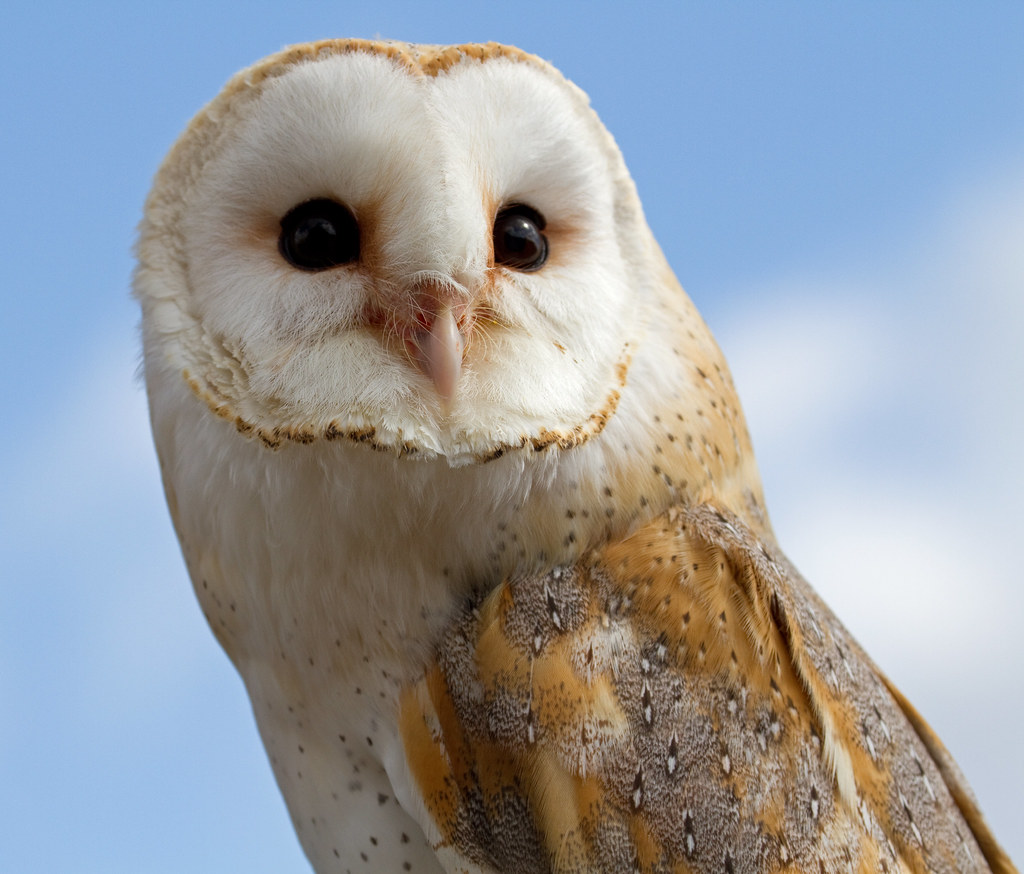
does the face above look threatening to you? Because if so, I suggest you look closer at the fluffiness of the face and the soft black eyes that will only be scary if you are prey or if you threaten them. (By the way, I have petted a Barn Owl, it was one of the softest feathers in existence.)
Please comment. And I hope that this post helped you in any way. Thank you and see you in the next post!
— Gloryruleshs
Comments
One response
So cool! But you shouldn’t say “cool, right?” So many times