Intro.
If you’ve ever taken a walk through a quiet forest at dawn or dusk in America or Canada, and saw a deer running trough the forest raising the white underside of its tail? That would be one of the America and Canada’s most famous deer Odocoileus virginianus—better known as the white-tailed deer. These elegant creatures are one of the most iconic and widespread mammals in North America, known for their agility, adaptability, and of course, their signature white tail that gives this very famous animal its name.

White-tailed deer (Odocoileus virginianus)” by GlacierNPS is marked with Public Domain Mark 1.0.
Appearance.
Can you see the white peeking out from behind it’s tail? That is their warning flag. When A white tailed deer senses danger or feels threatened by something, It raises its tail to show the white underside of its tail, signaling danger to the other deer. This is when they run or all start to look up from whatever they are doing to see what the others signaled about.

“White-tailed Deer in Yellowstone” by donjd2 is licensed under CC BY 2.0.
Other deer types.
But they are not the only ones who exist in the deer family. There are other types of deer al around the world, like White-tailed deer, Mule deer, Caribou (Reindeer), Key deer, Red deer, Sika deer, Roe deer, Fallow deer, Axis deer (Chital), Muntjac deer, Barasingha (Swamp deer), Marsh deer, Pampas deer to name a few of them. But there are more of course.

“White-tailed Deer – Odocoileus virginianus” by GlacierNPS is marked with Public Domain Mark 1.0.
Food and weight.
White-tailed deer families are herbivores, feeding on a varied diet of leaves, twigs, fruits, nuts, grasses, and fungi. The males grow antlers to fight with the other males over females, but after mating season is over the antlers fall off. They weigh about 126-302 pounds (57-137kg), With some differences in some subspecies. When the females known as Does leave for food, the babies are known to lay flat on the ground to camouflage their spots to look like foliage. Their fur is reddish brown in the summer and grey in the winters.

Winter White-tails” by rkramer62 is licensed under CC BY 2.0.
Velvet.
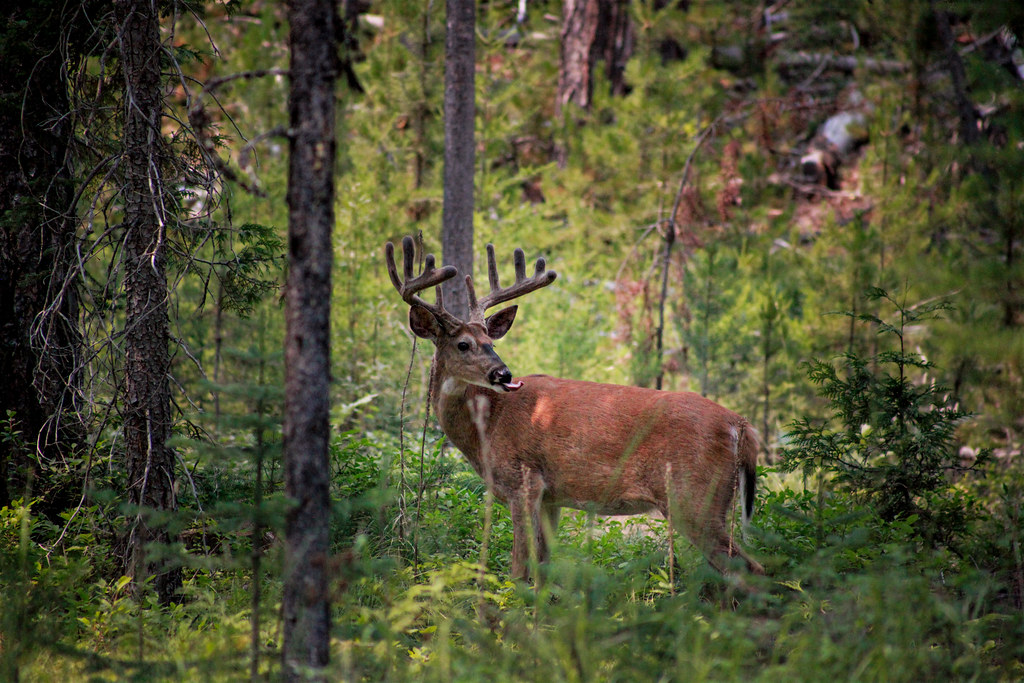
The Male White tailed deer has a soft fuzzy skin called velvet on their Antlers. Velvet supplies nutrients to the Antlers to help them grow. When the antlers are fully grown, The males rub the velvet off on trees and whatever else they can find. Animals such as moose also have velvet.

Can you see the fuzzy part on this Deer’s Antlers? That is the velvet. This is a picture of before a Deer rubs it off. It look like It’s skin is peeling off and is VERY gross. It looks like the Animal had a big fight and It’s opponents skin caught on the Animals Antlers or something. It is NOT pretty. But this is normal. Can you see the fluffy part? That us the velvet.
Dewclaws.
White tailed deer tracks are pretty much the same tracks of all other deer. They do have dewclaws but it’s very unlikely that the dew claws will show up unless the ground is soft or muddy. In case you were wondering, Dewclaws are a type of claw at the BACK of the paw or hoof. Dogs and cats also have dewclaws. Have you ever noticed the little thumb – like – thing on the back paw or hoof of your pet? That is the dewclaw. Here is a picture.

“Dewclaw of a cat” by WhisperToMe is marked with CC0 1.0.
Deer have dewclaws too, But they don’t look the same and leave little tracks sometimes. It looks a little different but other animals like canines and big cats also leave dewclaw marks sometimes. The Dewclaws on a deer can help it by providing traction and stability on soft or muddy ground. But if a deer was walking fast you may be able to see its dewclaw marks that look like little dots right behind the main hoof or paw tracks.

“P74 Whitetail Deer (Odocoileus virginianus) track with dewclaws” by wyldvision is licensed under CC BY 2.0.
Active times.
They are most active at dawn and dusk and rely on their sharp hearing and strong sense of smell to detect danger. During the fall rut (Which is a deers mating season) bucks seek out does to mate, and fawns are usually born in late spring or early summer. These deer are highly adaptable, commonly found in forests, grasslands, farmlands, and even near suburban areas. Even though they face predators like coyotes,bobcats, wolves, and humans, white-tailed deer remain resilient and able to bounce back from threats. They also continue to grow and thrive across a wide range of habitats and ecosystems.

“White tailed deer fawn in grass Sand Lake NWR” by USFWS Mountain Prairie is marked with Public Domain Mark 1.0.
Babies.
Baby White tailed deer are, ADORABLE. They have little, tiny eyes and adorable Bleats (That are like mom-summoning calls) That sound so cute and innocent, And they make your heart melt and sink into the ground. But DO NOT pet them. They are wild. Even if you want to pet them very badly, DO NOT PET THEM. Just watch it, if it seems hurt, And if you do not see a mother and you think its limping, Watch it a tiny bit more just to make sure, but if it bleeds a lot and here is no mother, take it to a ranger or a animal help personnel.

“Odocoileus virginianus (white-tailed deer) (Newark, Ohio, USA) 9” by James St. John is licensed under CC BY 2.0.
I will say it again, WHITE TAILED DEER FAWNS ARE SO CUTE!!!! When they are alone they usually lie down it a little ball and wait white predators cannot see them because of the shadows and the patterns on their backs. When they need help though, as I mentioned, they do their little adorable bleating sound which calls their mama to them.

“White-tailed Deer – Odocoileus virginianus” by GlacierNPS is marked with Public Domain Mark 1.0.
Okay to conclude this post, I will just say, White tailed deer are so interesting and fun to learn about! I hope you ad a amazing time learning about this amazing animal!
—Gloryrules