intro.
A little while ago, I had to opportunity to go to one of the most animal-abundant Galápagos Islands, and it was one of the most beautiful places I have ever been to. From pelicans to iguanas and everything in between, these islands amazed me beyond any place else.

This photo is by the author.
The arrival
The moment you arrive, unless you come from some warm country, or it is a very hot summer where you live, you are met with rush of warm air. Around you is landscape that looks like desert. You will probably walk into a big room with massive fans, around you is a line of people waiting to be admitted. The fans, in my opinion, Do little to help to sweltering heat. But there are screens with the rules of what and what not to do at the Galapagos and that is entertaining. You can also go to the bathroom here. Then you enter a place that looks like a normal airport; shops, bathrooms, bus takeoff areas. If you take a bus like me, it will take you around the mountains to the town, passing breathtaking ocean.

Lava gull. This photo is by the author.
transport to hotels and overall experience.
Then you will go on a taxi to individual locations. You will tell the taxi driver where you will stay, (In my case, it was a hotel) and they will drop you off there. Then, you will most likely drop off your things and go to sleep, go to a tour agency, or go to a beach. On my trip, we went to a beach called Playa de la Estacion. The beach there is pretty, with sea lions lying in the sand literally everywhere. The waters are cool, but the rocks are slippery and sharp and will cut you all over in the strong currents if not careful, but the fish and crabs are abundant, and the water is such a beautiful blue color that it makes people stop and stare. I stayed in Santa Cruz, the second biggest island in the Galapagos. The town was filled with amazing restaurants with a variety of seafood dishes that were all very good.

sea lion on dock. This photo is by the author.
Sea lions.
when I first arrived, my expectations for wildlife were not very high. I had heard of iguanas and Blue-footed-boobies on the islands, but from the moment we arrived at Playa de la Estacion, I saw a massive Galapagos sea lion lying in the shade, asleep, next to the sunbathers. Now, the moment you arrive, you are told to keep 6 feet of distance away from the wildlife, but no matter how you try, there will be at least one time per day when you are much, MUCH, closer than that. It is unavoidable for anyone. But everyone does not touch the wildlife, which is very good. The sea lions are too cute, and to spread out in all directions. They lie on the Playa de la Estacion beach for hours, sleeping. It is so cute. The sea lions, when they get too hot, will move into the shade and/or dive into the water. This makes you able to swim with the sea lions and is amazing. Another thing I should mention is that no one follows the rule to keeps six feet away for the wildlife. The wildlife are CHILLING.

sea lions at a beach in San Cristobal Island. This photo is by the author.
Blue-Footed-Boobies.
The Blue-Footed-Boobies are like the mascots of Santa Cruz. They are in merchandise, they are in bookstores, they are on the covers of restaurant menus, it is so cute and at the same time so funny, but when you see a Blue Footed Booby, they are so amazing, one because they are VERY MUCH BLUE FOOTED, and because even if you wish for it, you will not be able to see a baby. This is because they nest in the tiny crevices of the cliffs, so they are not many sightings of the babies. But yet they are still so cool. Another thing I should mention as we are on the topic, is that there are three types of Boobies in the Galapagos. The Red Footed Booby, the Blue Footed Booby, and the Nazca Boobies. The Blue Footed ones are the most famous in my opinion, but there are tons more.

Blue Footed Boobies on the rocks. This photo is by the author.
Iguanas.
There are tons of small marine Iguanas, but not that many big ones, or maybe it’s just the time that I went that was bad for the iguanas, but I did get to see some. They were massive and scaled and left lines in the sand with their tails wherever they went. But they were not always so abundant. They used to be, and still are, dying out because of the rats that the first settlers brought with them. They used to dig them up. The rats were also a problem for the Galapagos tortoise species, in extreme cases going up to what happened to lonesome George, who we will talk about later. Nowadays, they are putting rat traps in rat mating zones to kill all of them before they become a problem again. The Iguanas are also very beautiful in some ways, with black scales glinting in the sun, they love to sunbathe on the cold, wet rocks of their home. The rocks are black like the iguanas themselves.

This photo is by Niki Wunderlin, an amazing photographer.
Tortoise/ lonesome George.
Lonesome George was not always so lonesome. He was once only one of the many of his kind, the Pinta island tortoises, with their long necks, they were an amazing species. But then sailors came to the island and after staying there some time, they got hungry and ate some tortoises. Then the ships they came on had rats, and those rats came onto the island and started eating the tortoise eggs, this cycle repeated until there was only one Pinta Island tortoise. Lonesome George. He was put in a massive pen with bars on all sides. Lonesome George passed away at the age of 100-116. The Tortoises off the Galapagos are born about the size of a baseball. They are kept in tiny concrete boxes without good or water for a month. This is to simulate the harsh environment in their natural habitat, then they go to a bigger pen, when they are about the size of a pet turtle. After that they go to a slightly bigger enclosure, then to the one that had tortoises big enough for a toddler to ride on no problem. They fully become adults at 25-30, but they can live to 100 years old or more. Some of the original parents of the now thousands of baby tortoises are scarred from a lava flow a long time ago.

Galapagos tortoises. This photo is by the author.
Pelicans.
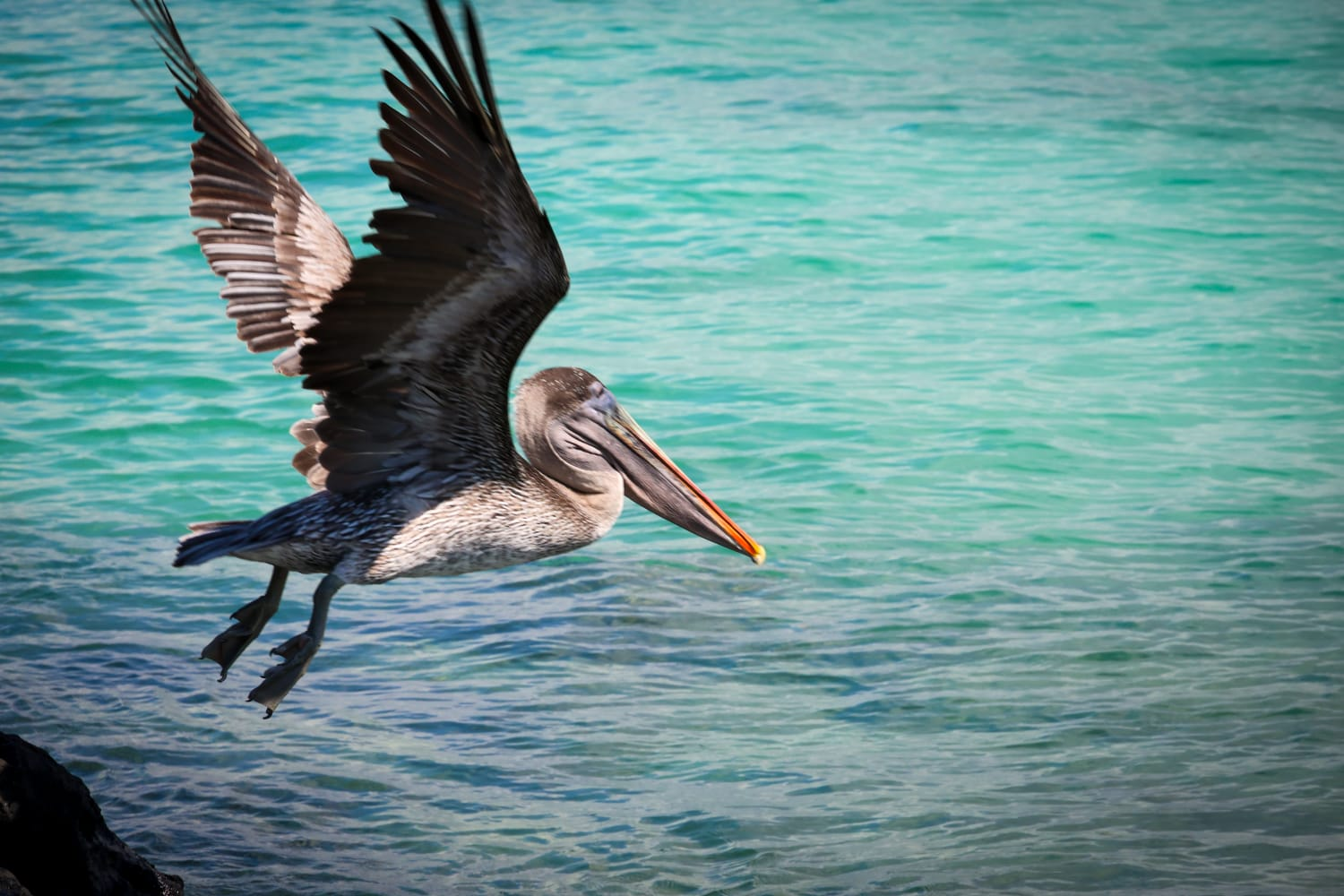
Of course, one of the most seen animals in the Galapagos are the pelicans, they flap their wings and fly far and wide in the islands. They eat the fish scraps from the fishermen and nest in the crevices and cliffs in the sea rocks. They are yellow with brown wings and are very beautiful when flying. Their scientific name is pelecanus occidentalis. They can also have plain heads and be all brown.

This photo is by Niki Wunderlin, an amazing photographer.
the brown pelican are a very common species to the Galapagos and especially to Santa Cruz.

This photo is by Niki Wunderlin, an amazing photographer.
Okay now the history.
The Galápagos Islands are islands in the ocean near Ecuador. They were made by volcanoes a very long time ago. For many years, no people lived there. Only animals and plants lived on the islands, and many of them became special and different because the islands were far away from other land, and they could not swim there, this is also why there are no frogs or animals like that, because the journey is too much to handle for them. And In 1535, a man named Fray Tomás de Berlanga found the islands by accident when his ship got lost. He wrote about the dry land, the black rocks, and the large tortoises he saw. After this, pirates and sailors came to the islands. They stopped there to rest and get food. They took many tortoises and other animals, which made some animal groups smaller. In 1832, Ecuador took control of the islands and made them part of the country. In 1835, a scientist named Charles Darwin visited on a ship called the HMS Beagle. He studied the animals and noticed small differences between animals on each island. This helped him later think of new ideas about how living things change over time. He is now very famous for thinking about evolution.

“CHARLES DARWIN IN SHREWSBURY” by summonedbyfells is licensed under CC BY 2.0.
Today, the Galápagos Islands are a much loved national park and a wonderful vacation spot, but they do have challenges. So make sure you donate to the Galapagos or help in some way.
—Gloryrules
Comments
2 responses
spectacular post, I want a p2 very soon! or a post about lions or jaguars! –thankyou1234welcome
I love this!